
Repeal
Repeal is the removal or reversal of a law.

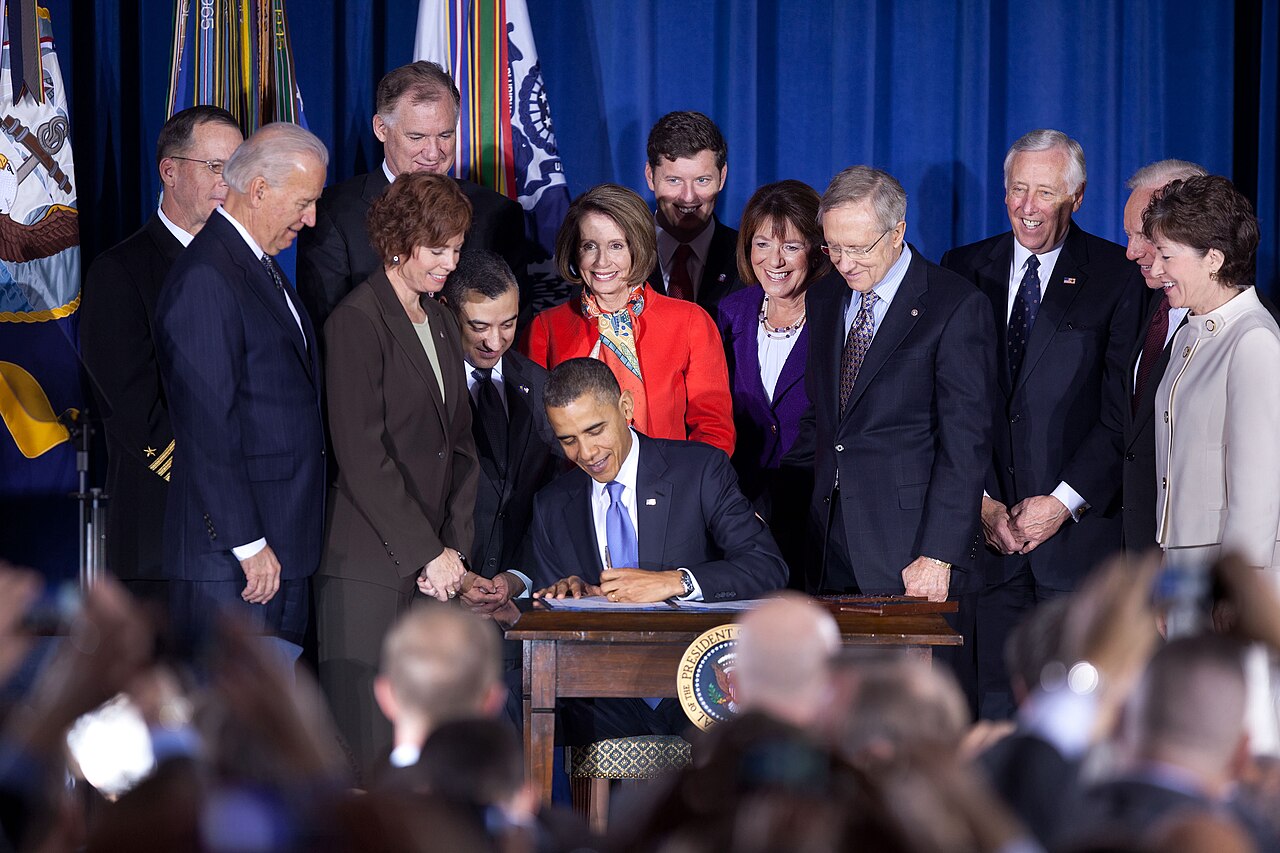
Senate Democrats · CC BY 2.0
Repeal is the removal or reversal of a law. There are two basic types: repeal with re-enactment, which replaces the law with an updated or amended version, and repeal without replacement, which abolishes its provisions entirely. In parliamentary procedure, the motion to rescind, repeal, or annul is used to cancel or countermand a previously adopted action.
- field
- Law and parliamentary procedure
- known_for
- Removal or reversal of laws, including partial or full repeal, express or implied repeal, and repeal with or without savings
Lore & Background
Removal of secondary legislation is normally referred to as revocation rather than repeal in the United Kingdom and Ireland. A partial repeal occurs when a specified part or provision of a previous Act is repealed but other provisions remain in force; a full repeal occurs where the entire Act in question is repealed. Repeal without replacement is generally done when a law is no longer effective or is shown to have far more negative consequences than originally envisioned.
Reader's Guide
Repeal is a fundamental mechanism in legal systems for updating or removing laws. It can be express, where explicit words in a statute repeal an earlier one, or implied, where two statutes are mutually inconsistent and the later statute repeals the earlier one pro tanto. In the United States, all repeals of parts of the U.S. Code are express, requiring Congress to pass a new law containing repeal language. Repeals can be with or without savings; a repeal without savings eliminates the repealed statute completely, while a repeal with savings preserves its effect for limited purposes. In parliamentary procedure, the motion to rescind, repeal, or annul requires a two-thirds vote, a majority vote with previous notice, or a vote of a majority of the entire membership under Robert's Rules of Order, while The Standard Code of Parliamentary Procedure requires only the same vote and notice as the original action.
Did You Know?
- The repeal of a statute under common law of England and Wales was said to 'obliterate it completely from the records of Parliament as though it had never been passed.'
- The Twenty-first Amendment to the U.S. Constitution repealed the Eighteenth Amendment, making it the only constitutional amendment ever repealed in the United States.
- A repeal without replacement is generally done when a law is no longer effective or has far more negative consequences than originally envisioned.
Gallery




Frequently Asked Questions
What is Repeal in legal terms?
Repeal is the formal process by which a legislature removes or reverses an existing statute, stripping it of its legal force. It can target an entire law or only specific provisions within it.
What are the two basic types of Repeal?
Repeal with re-enactment replaces the old statute with a revised or updated version, while repeal without replacement simply abolishes the provisions and leaves no successor law in their place.
How does Repeal function in parliamentary procedure?
Within a legislative body, the motion to rescind, repeal, or annul is the procedural tool used to cancel or countermand a previously adopted action. It allows the assembly to formally undo decisions it has already made.
What is the difference between express and implied repeal?
Express repeal explicitly names the statute being removed in the text of the new legislation, whereas implied repeal occurs when a newer law's provisions conflict so directly with an older one that the older law can no longer be enforced.
Why is Repeal significant in law enforcement and legal practice?
It gives legislatures the mechanism to correct outdated, redundant, or unjust rules and keep the legal code coherent. Without repeal, conflicting or obsolete statutes would accumulate, creating confusion for both enforcers and the public.
More in Law Enforcement & Legal Procedures 1-24
Spotted an error? Know more?
This is a living reference — every entry is fact-audited, and reader corrections feed straight into our audit queue. Suggest an edit · See this site's audit record